Publish Date
May 6, 2026
Excerpt
Cannabinoid beverages are the fastest-growing edible category in mature cannabis markets, and hemp-derived THC drinks are expanding nationally. But the manufacturing process behind them is fundamentally different from conventional beverage production, and meaningfully different from other cannabis edibles. Here's what actually happens between a brand's concept and a finished product on the shelf.
Page Image
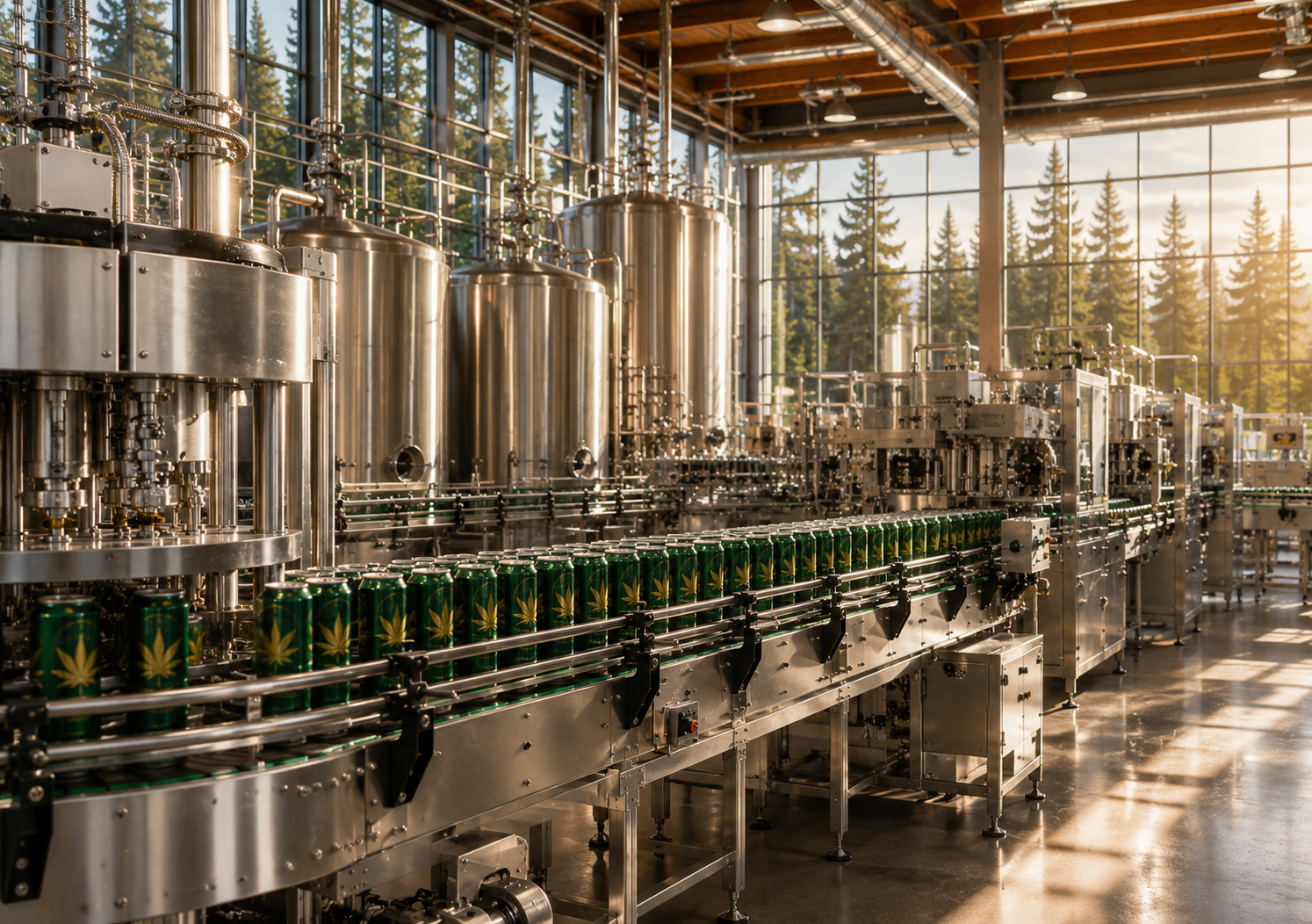
Picture of Architecture, Building, Factory, Brewery, Lamp, Manufacturing

Cannabinoid Beverage Manufacturing: From Formulation to Shelf

  • May 6, 2026

Cannabinoid Beverage Manufacturing: From Formulation to Shelf

  • May 6, 2026

Cannabinoid beverages are the fastest-growing edible category in mature cannabis markets, and hemp-derived THC drinks are expanding nationally. But the manufacturing process behind them is fundamentally different from conventional beverage production, and meaningfully different from other cannabis edibles.

Here's what actually happens between a brand's concept and a finished product on the shelf.

Step 1: Formulation and R&D

Every cannabinoid beverage starts in the lab. The formulation phase determines your product's flavor, dosing, stability, and consumer experience.

What Happens

  • Base beverage development: the liquid itself. Flavor profile, sweetener system, carbonation level, mouthfeel. This is the same craft that goes into any beverage, and it needs to taste good independent of the cannabinoid component.
  • Emulsion preparation: creating the nano-emulsion that makes THC water-compatible. This involves selecting the right surfactant system, processing the cannabinoid extract through emulsion equipment, and testing particle size and stability.
  • Dosing calibration: hitting the target THC per serving with precision. Regulatory limits vary by state and product type (10mg per serving is common for state-legal cannabis; hemp products face their own evolving limits). The emulsion must distribute evenly so every pour or sip delivers a consistent dose.
  • Stability testing: how the product holds up over time. Does the emulsion stay suspended? Does the flavor degrade? Does the carbonation hold? Accelerated stability studies can answer these questions in weeks rather than months.

Timeline

Expect 2-4 weeks for a new formulation with a co-manufacturer who has in-house R&D capability. Adapting an existing formula for a new market's compliance requirements is typically faster, around 1-2 weeks.

Step 2: Compliance and Pre-Production

Before a single bottle is filled, there's a compliance process to work through. The specifics vary by state for cannabis and are evolving for hemp, but the structure is similar everywhere.

Regulatory Requirements

For state-legal cannabis (using Washington as an example):

  • State licensing review: your product must conform to the state's processor requirements. In WA, that's I-502; other states have their own frameworks.
  • Label approval: cannabis beverage labels require specific elements: THC content per serving and per package, state-mandated symbols, warning statements, lot numbers, and license numbers. Getting the label right before production saves costly reprints.
  • Seed-to-sale registration: in most cannabis states, every product must be registered in the state tracking system (CCRS in Washington, METRC in many other states) before it can be manufactured, transferred, or sold.
  • Food safety verification: the facility must meet state food safety standards. Production protocols, sanitation schedules, and HACCP plans should all be current and inspected.

For hemp-derived products, the compliance picture is different. No state cannabis license is required, but you're navigating FDA food safety rules, state-level hemp product regulations, and testing/labeling requirements that vary by where you're selling.

Pre-Production Checklist

Pre-production checklist
Item
Responsibility
Typical Timeline
Formula finalized and tested
Co-manufacturer + brand
2-4 weeks
Label designed and compliant
Brand (with co-manufacturer review)
1-2 weeks
Product registered in tracking system
Co-manufacturer (cannabis)
1-3 days
Raw materials sourced and received
Co-manufacturer
1-2 weeks
Packaging materials on hand
Brand or co-manufacturer
2-4 weeks (cans/labels lead time)
Production scheduled
Co-manufacturer
Varies

The packaging lead time catches brands off guard most often. Custom-printed cans and shrink sleeves have 2-4 week lead times. Pressure-sensitive labels are faster. Plan packaging procurement early.

Step 3: Production

Production day is where formulation meets engineering. Here's the typical flow for a canned cannabinoid beverage:

Blending and Infusion

  • Base beverage batched: water, sweeteners, flavoring, and acids mixed in a brite tank according to the formulation spec
  • Nano-emulsion added: the pre-prepared THC emulsion is metered into the batch at precise ratios to hit the target dose per serving
  • Carbonation: for carbonated products, CO2 is injected to the target volumes (typically 2.5-3.5 volumes for seltzers and sodas)
  • QC sample pulled: a sample goes to the lab to verify THC content, pH, brix, and carbonation level before the batch moves to the fill line

    Filling and Packaging

    Filling and Packaging
    • Cans depalletized and rinsed: empty cans are loaded, inverted, and rinsed before filling
    • Counter-pressure fill: the carbonated beverage is filled under pressure to maintain carbonation levels. Fill volume is monitored for accuracy.
    • Seaming: lids are placed and seamed. Seam integrity is critical for shelf life and product quality.
    • Nitrogen dosing (for still beverages): non-carbonated drinks in cans receive a small dose of liquid nitrogen before seaming. The nitrogen expands, pressurizing the can for structural rigidity. Without it, still beverages in aluminum cans feel flimsy and dent easily.
    • Labeling: shrink sleeves applied and run through a steam tunnel, or pressure-sensitive labels applied via automated labeler
    • Date coding: production date, lot number, and best-by date coded onto the can
    • Pack-off: finished cans packed into cases, palletized, and moved to storage

      Quality Control

      Throughout production, QC checkpoints verify:

      • Fill volume (within tolerance)
      • Seam integrity (destructive testing on sample cans)
      • THC potency per serving (lab-verified)
      • Visual inspection (label placement, print quality, can condition)
      • Carbonation level (for carbonated products)

      These checkpoints are built into the production flow so issues are caught early rather than discovered after a full run is complete.

      Step 4: Testing and Release

      Most cannabis states require independent third-party testing of all products before they can be sold. Hemp products face similar testing requirements in many states.

      Common Required Tests

      Common Required Tests
      • Potency: confirms THC and CBD content per serving and per package
      • Pesticides: screens for prohibited pesticide residues
      • Heavy metals: tests for lead, arsenic, cadmium, and mercury
      • Microbial: checks for harmful bacteria and mold
      • Mycotoxins: screens for toxins produced by mold

      Testing typically takes 3-7 business days. Your co-manufacturer should have a relationship with an accredited testing lab and manage the sample submission process.

      Product cannot be transferred or sold until test results come back clean. This is standard practice and one of the reasons production quality and sanitation protocols matter. They prevent delays and wasted product.

      Step 5: Warehousing and Distribution

      Once a batch passes testing, the product is ready for the market.

      Getting to Retail

      For state-legal cannabis, every unit must be logged in the state tracking system before it can leave the facility. Transfer manifests document what's moving, where, and when.

      For hemp products, the logistics are more conventional: standard shipping and warehousing, with COAs (certificates of analysis) accompanying each batch.

      Some co-manufacturers offer distribution as part of their service, including warehousing, sales, and delivery through established retail relationships. Others focus on production and hand off finished goods to the brand. Either model works; it depends on whether you already have your distribution figured out or need help getting to market.

      The Timeline, End to End

      Phase
      Duration
      Notes
      Formulation & R&D
      2-4 weeks
      Faster if adapting existing formula
      Compliance & pre-production
      1-3 weeks
      Label and packaging lead times are the bottleneck
      Production
      1-3 days
      Depends on batch size
      Testing
      3-7 business days
      Third-party lab, required in most states
      Release to market
      1-2 days
      Tracking system transfers, delivery scheduling
      Total
      4-8 weeks
      From approved formula to product on shelf

      Frequently Asked Questions

      Can I use a formula I developed in another state?

      Usually, yes, but it may need adaptation for the target market's compliance requirements. Dosing limits, ingredient restrictions, and labeling requirements vary by state. Your co-manufacturer should be able to assess what needs to change.

      Who owns the formulation, me or the manufacturer?

      This should be clearly stated in your manufacturing agreement. Standard practice is that the brand owns its formulation. Make sure it's in writing.

      What's a typical minimum order for a first production run?

      It varies by manufacturer. Some require 5,000+ units. Others support pilot runs of a few hundred cases. Smaller initial runs let you test the market before committing to scale.

      Can one facility produce both cannabis and hemp beverages?

      Some can. Dual-capability facilities can produce state-legal cannabis products and hemp-derived products from the same production infrastructure, which is useful for brands that want to operate in both channels from a single manufacturing relationship. Some states require a separation between the physical facilities, although the equipment used is the same.

      What happens if a batch fails testing?

      It depends on the failure. Some issues may be retestable. Others may require the batch to be quarantined or destroyed. This is rare when formulation and production processes are dialed in, but it's a reality of operating in a regulated category.

      Want to Understand the Process Better?

      If you're exploring co-manufacturing for a cannabinoid beverage, we're happy to walk you through how the process works for your specific product: formulation, production, compliance, and timeline.